2026-10-20
Content
A 2.5-ton diesel counterbalance truck moving at 8 km/h in a 3.4 m aisle needs roughly 5.9 m to stop: about 1.5 seconds of operator reaction time plus some 2.6 m of braking on dry concrete. If a picker steps out from behind a racking upright four metres ahead, the truck cannot stop inside the space that exists. That single calculation explains why most forklift-pedestrian near misses in warehouses are not the work of a careless driver, but of a layout and a truck selection that left no margin for error in the first place.
Preventing forklift-pedestrian collisions in a warehouse is not one product and not one rule. It is four stacked layers: keep people and trucks physically apart wherever the building allows it, keep both visible to each other where they must share the same floor, hold speed and traffic direction so that stopping distance stays shorter than sight distance, and train behaviour so the first three layers still hold at two in the morning on a Friday night. Remove any one layer and the other three carry a load they were never sized for.
Three changes give the fastest return in almost every facility: mark and physically protect a walkway that sits completely outside the truck travel path, cut aisle speed to 8 km/h or less and crossing speed to 5 km/h, and fix every blind corner with a mirror, a projection light or a barrier, then enforce a stop-and-proceed rule at each one. Everything below builds on those three moves.
Planning figures in this guide assume dry concrete, a laden truck and a trained operator. Stopping distance changes with load weight, tyre type, floor finish, mast height and battery or fuel condition, so confirm the numbers against the truck's own operating manual before you write a site speed limit into policy.
Safety equipment catalogues often treat these layers as alternatives. They are not. They are ranked: each layer below the first one is a fallback for the cases where the layer above it cannot be applied.
Walkways behind racking or along a wall, barriers at aisle ends, pedestrian gates, dedicated doors for people and separate doors for trucks. This is the only layer that does not depend on anyone paying attention.
Convex mirrors at intersections, lighting levels that remove dark zones, loads lowered so the operator can see forward, and warning lights that announce a truck before it reaches the corner.
Posted limits, one-way aisles, stop-and-proceed crossing points, speed governors on electric trucks, and lane discipline that keeps a reversing truck out of a walking route.
Operator certification, pedestrian induction, near-miss reporting, and supervisors who correct a shortcut the first time they see it instead of the third.
When a collision or a serious near miss is reviewed, the pattern is almost always the same: two or more layers failed at the same point in the building at the same minute. A blind corner with no mirror, a walkway stripe that wore away three months ago, and a truck running above the posted limit because the shift is behind schedule. Fixing any one of those three would have broken the chain.
The ranking follows the same hierarchy used in machine guarding: eliminate the exposure first, then guard it, then warn, then train. Warning devices and training sit at the end of that list, not the beginning, and they are the two controls most often installed alone.
Understanding the causes matters because each cause points at a different fix. A speed problem is not solved by a new walkway, and a blind corner is not solved by retraining operators who already drive correctly.
Racking uprights, stacked pallets, shrink-wrapped loads and open fire doors all create corners where a walking person appears with less than one second of warning. At 8 km/h a truck covers 2.2 m in a single second, so a pedestrian emerging 2 m from the truck's path is effectively invisible until it is too late for any reaction to be useful.
Picking, replenishment and put-away scheduled into the same aisle at the same hour is the most common structural cause of near misses. The truck needs the full aisle width to turn into a rack bay; the picker needs the same floor to reach the pallet. Neither task is unsafe on its own. Combined at the same minute, they remove the aisle as a safe space for either.
A counterbalance truck with a 1.07 m body and a 1.2 m pallet needs an aisle of roughly 3.4 m to 3.8 m to turn cleanly with clearance. Push the same truck into a 3.0 m aisle and the load swings over the walkway strip while the operator concentrates on not hitting the racking. Every millimetre of clearance lost is taken from the pedestrian's safety margin, not from the racking's.
Lithium and lead-acid electric trucks at low speed produce very little noise, particularly on smooth concrete. Workers whose hearing has adapted to a noisy warehouse, or who wear ear protection for other equipment, often do not register an approaching electric truck until it is inside the aisle. Diesel and LPG trucks are easier to hear and therefore easier to track, which is a genuine behavioural difference worth planning around.
Pedestrian traffic is never evenly spread. It peaks at shift change, at break times and around the shift office, the canteen and the washrooms. Dock doors and personnel doors that open into a truck lane turn a quiet area into a crossing point several times a day, and those are exactly the minutes when operators are also in a hurry.
A load stacked above roughly 1.2 m hides the floor immediately in front of the truck. Operating guidelines for this situation are clear: travel in reverse with the load trailing on the flat, or lower the load and use a spotter. Many sites accept the forward view problem as normal because reversing feels slower, and the risk is quietly transferred to whoever is standing on the other side of the load.
Stretch wrap, broken pallet boards, spilled pellets and loose straps force pedestrians to step around obstacles, often into the truck lane. They also change braking performance and can throw a truck off line when a drive wheel passes over them.
Temporary workers are frequently placed in the highest-traffic parts of a warehouse on their first day, with a short induction delivered in a language they may not read comfortably. Pedestrian induction is the single most skipped training in most facilities, and it is also the one that protects people who have no experience of how quickly a loaded truck moves.
The most durable fix for pedestrian collisions is choosing a truck that fits the aisle rather than forcing an aisle to accept a truck. Narrow-aisle equipment does not simply save space; it changes how much floor a truck occupies during a turn, how far the load swings past the racking, and how much of the aisle remains available to a person on foot.
Three measurements decide the answer: the truck's overall width with the load, the required right-angle stacking aisle, and the minimum clearance you are prepared to leave between the load and the racking on both sides. A practical working rule is 300 mm to 400 mm of clearance per side in a shared aisle, and more where pallet quality varies between suppliers.
| Aisle width | Truck type that fits | Geometry note | Priority pedestrian control |
|---|---|---|---|
| Under 2.5 m | Reach truck or turret truck with rail or wire guidance | Operator cannot see around the mast and load; guidance is required rather than optional | No pedestrians in the aisle while the truck works; interlocked gates at both ends |
| 2.5 to 3.2 m | Stand-up reach truck, electric stacker | Load and forks swing into the aisle during turns; the tail sweeps the opposite side | One person per aisle rule, audible warning at aisle entry, no passing |
| 3.2 to 3.8 m | Reach truck or 1.5 to 2 ton counterbalance | Fits a 1.2 m pallet with clearance on both sides when turning is planned | Marked walkway outside the travel path, physical barrier at the aisle end |
| 3.8 to 4.5 m | 2 to 2.5 ton counterbalance, electric or diesel | Allows 90 degree turns with a loaded pallet without reversing manoeuvres | Defined crossing points with a stop-and-proceed rule painted on the floor |
| Over 4.5 m open floor | 3 ton and above counterbalance, order pickers | Space invites speed and overtaking, which is the real risk in wide bays | Lane discipline, one-way routing, posted limits enforced by telematics |
Where the aisle is tight and the building cannot change, a reach truck is usually the correct answer rather than a smaller counterbalance truck, because the reach mast keeps the truck body out of the rack bay during the lift stroke and puts less machine into the aisle at the moment of highest pedestrian risk.
If you are still deciding which class of truck belongs in a given aisle, this comparison of warehouse forklift types is a useful starting point before you request quotes, because the aisle measurement drives the answer far more than the load weight does.
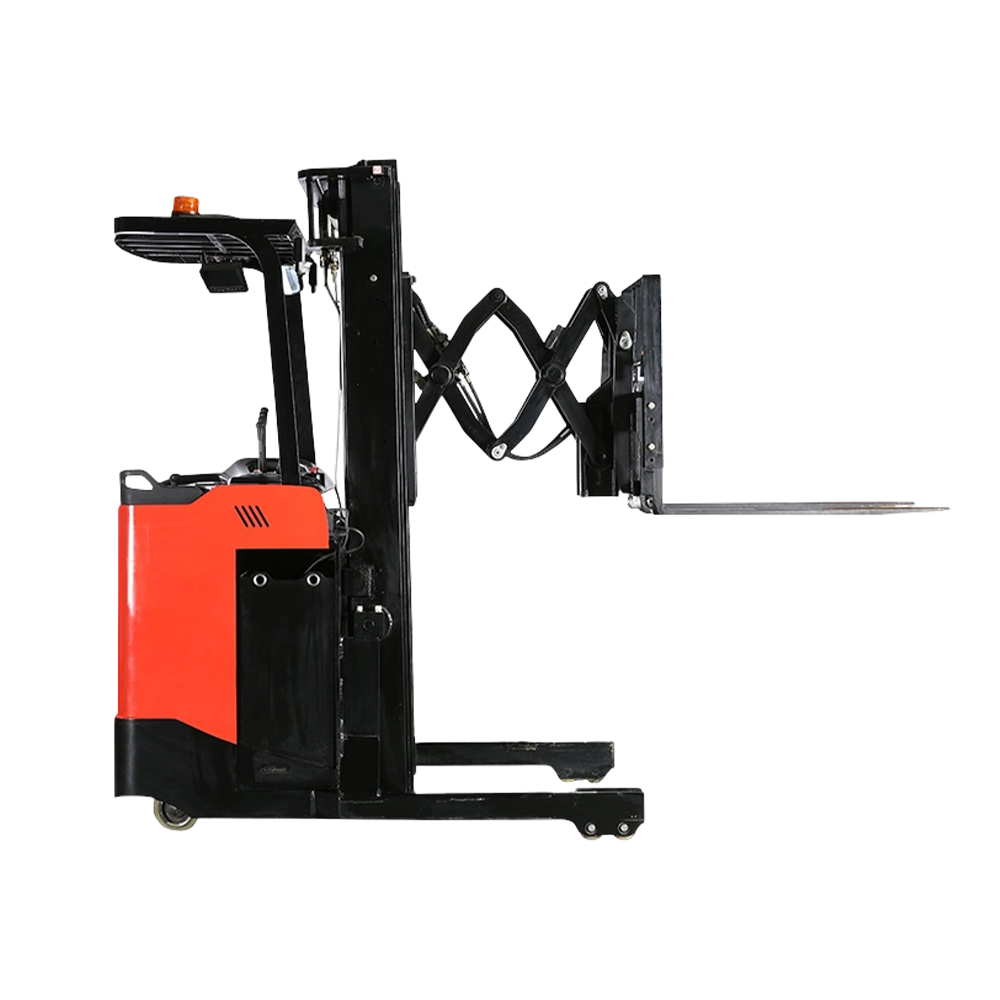 1.2吨电动前移式叉车,适合窄通道作业该站驾式前移式叉车以紧凑转弯半径和精确操控降低安全风险,其制动距离和能见度设计在狭窄通道中尤为重要。View Product →
A speed limit is only meaningful if it is derived from something. The usable method is to measure the clear sight distance at each hazard, then set the limit so that total stopping distance is shorter than that sight distance. A corner where an operator can see 4 m ahead of the forks cannot carry a speed that needs 5.9 m to stop.
Stopping distance by speed
Doubling speed takes stopping distance up by roughly four times, because braking distance rises with the square of velocity while reaction distance rises only in a straight line. That is why a truck that feels entirely controllable at 12 km/h in an empty aisle becomes uncontrollable at the same speed when a person appears 6 m away.
Recommended limits by zone
Beyond the posted number, the rules that carry the most weight at intersections are behavioural and simple enough to enforce:
Speed limits that are posted but physically impossible to respect, such as 5 km/h across a 60 m main lane, get ignored within a week. Set limits zone by zone so that they can actually be obeyed, then check compliance with telematics data rather than with a clipboard.
Floor marking is the cheapest of the four layers and the one that degrades fastest. A walkway that was clearly delineated two years ago and is now a faded grey smudge offers no protection, and often creates false confidence in an audit.
Practical specification points that hold up on a working floor:
Where the layout allows it, take the walkway out of the aisle entirely. A route along the wall or behind the racking costs floor space and is worth it, because it removes the shared-floor condition rather than managing it. Where that is impossible, a raised or kerbed walkway of 50 mm to 100 mm makes the boundary tactile as well as visual, and a pedestrian who steps off it can feel that they have left the safe zone.
The lighting that illuminates the markings matters as much as the paint. Aim for uniform lighting along the walkway with no dark segments under high racking, and keep the contrast high enough that a worker wearing a dark uniform is visible against the floor rather than blending into it.
Barriers do one job that no sign can do: they make the wrong action physically awkward rather than merely prohibited. Three placements deliver most of the benefit in a typical distribution building.
Installed on the outside of a blind corner, a rail forces the operator to slow and swing wide, which converts a fast impact angle into a glancing one and gives the pedestrian behind the racking an extra metre of warning space.
Upright protectors prevent the low-speed frame strikes that release stored energy into the racking and drop loads into the aisle where people walk. They also stop the pallet debris that forces pedestrians into the truck lane.
At the entry to a working aisle, a spring-return gate or an interlocked barrier keeps the aisle clear when a truck is inside it. An interlock that stops the truck if the gate opens is stronger than a rule that depends on people remembering.
Barrier damage is a metric worth tracking. A bent rail tells you where trucks are actually making contact, which is usually where pedestrians are also walking. Repair barriers within days rather than months, because a damaged barrier stops being respected within a couple of weeks of the damage appearing.
At dock aprons and loading areas, the highest-risk combination is a truck reversing while a person stands at the edge of the leveller. A separate pedestrian door from the dock office, plus a marked crossing behind the reversing envelope, removes that exposure more effectively than any amount of warning signage painted on the wall.
Sight lines are a measurement, not an impression. Stand at the point where a pedestrian would step out, and check how far down the truck lane an operator approaching from either direction can be seen. If the answer is under 5 m, the corner needs hardware.
A convex mirror mounted at 2 m to 3 m height, angled so that both the operator and the pedestrian can see the other lane, removes most of the surprise at a right-angle corner. Mirrors fail for three reasons: they are set at the wrong angle after someone bumped them, they are dirty, or they are mounted so low that a stacked load blocks them. Add mirror adjustment to the weekly housekeeping checklist.
Warehouse aisles with mixed pedestrian and truck traffic generally need uniform light in the range of 200 to 300 lux at floor level, with the walkway brighter than the storage bays so that people are seen against a darker background. High-glare fittings that reflect off a polished floor or a shrink-wrapped pallet make pedestrians harder to see, so the fitting type matters as much as the raw output.
Warning lights mounted on the truck are only useful if they are aimed where people walk. Floor-projection and zone lights that place a moving mark on the ground ahead of the truck are read by pedestrians who are looking at the floor, which is most of them when they are walking with a pick list. Audible warning must also cut through ambient warehouse noise, which in busy areas can sit between 70 and 85 decibels, so a reverse alarm that was audible in an empty building may be inaudible at peak.
Whatever device you install, test it during the busiest hour of the busiest shift. A warning that works in a quiet test walk-through and fails when two trucks and a forklift are working the same bay is worse than no warning at all, because it creates the belief that the corner has been solved.
Operator training is well established in most facilities; pedestrian training usually is not. Both audiences need sessions, and the pedestrian session is often the one that prevents the next incident, because the person on foot is the only party who can see what is coming from both directions.
For operators, the elements that matter most in day-to-day performance are:
For pedestrians, five rules cover most of the exposure in a busy warehouse. Make eye contact with the operator and wait for an acknowledgement before crossing. Never walk under a raised load or between a truck and the racking. Use the marked walkway even when the direct route through the aisle is shorter. Keep out of the tail swing zone behind a turning truck. Report every near miss, including the ones that ended with nothing happening.
Near-miss reporting deserves its own mechanism. A no-blame form, a visible count on a board and a short weekly review of what changed as a result turn near misses into a free hazard map of the building. Facilities that collect 20 or more near-miss reports a month are usually safer than facilities that collect two, because the second group has stopped reporting rather than stopped having near misses.
Agency and temporary workers need a shortened induction delivered in a language they can read, plus a buddy for the first shift. Placing a first-day worker in the highest-traffic aisle during shift change is a planning error, not a training failure.
Detection technology has moved from experimental to practical, but it changes the risk profile rather than removing it. It belongs on top of separation and sight lines, not instead of them, and the selection criteria are operational rather than technical.
Systems range from simple ultrasonic sensors that trigger an alarm when something enters a defined envelope, through radio-frequency tags carried by pedestrians, to camera-based detection that distinguishes a person from a pallet. The questions worth asking before purchase are: what is the detection zone in metres, what happens on a false alarm, does it work around a corner, and what is the total cost per truck plus per person tagged. A system that is switched off because it alarms constantly on racking uprights adds cost and no protection.
Geofenced speed limiting holds a truck at the aisle limit automatically and releases it in open areas. Access control, usually by card or PIN, prevents untrained staff from moving a truck to clear a doorway, which is a common source of incidents at shift change.
Fleet data records harsh braking, speed events, impact detection and hours in service. Reviewed monthly, it shows which aisles generate the most hard braking, which is a strong indicator of where pedestrians and trucks are meeting unexpectedly. Impact detection logs also capture the low-speed knocks that operators would otherwise never report.
The sensible sequence is separation first, then sight lines, then speed control, and technology to hold the standard as the site grows or as staffing changes. Buying detection before marking a walkway is spending money on the symptom.
Not every pedestrian in a warehouse is a passer-by. Operators of electric pallet trucks, electric stackers and order pickers work on foot, often walking backwards to pull a load, with their attention on the pallet rather than on a counterbalance truck approaching from behind. They are pedestrians and truck operators at the same time, which makes them the most exposed group on the floor.
Three controls reduce that exposure without slowing picking:
Equipment selection in storage and staging areas matters more than most planning documents admit. A low-level order picker that keeps a person at one level with a clear view forward removes an entire category of exposure compared with an operator who must repeatedly step off and on a truck in a live aisle.
 1.5吨电动堆高车,适合短距搬运与拣选这款步行式电动堆高车以紧凑结构和清晰视野提升操作安全性,在分拣区频繁上下车场景中减少暴露风险。View Product →
In areas where loads move short distances across a shared floor, the choice between a powered walk-behind unit and a ride-on counterbalance truck also changes how much aisle a pedestrian needs to avoid. For high volumes of short-haul pallet movement, a lithium electric pallet truck keeps a single person in control of the load at low speed, with the operator positioned to see the route ahead rather than sitting behind a mast.
 1.5吨锂电托盘车,适合跨区短途运输此锂电托盘车以轻薄车身和长续航满足高频短途搬运,操作者站立前方可清晰观察路径,降低与行人的碰撞风险。View Product →
Where a facility handles several truck types across different zones, matching each aisle to the lightest suitable machine is the most effective single decision for pedestrian safety. The layout principles behind warehousing and logistics operations cover this zoning question in more detail.
You do not need a consultant to find the collision points in a warehouse. You need one day, a tape measure, a stopwatch and someone who is willing to walk the floor at the worst time of day rather than the quietest.
Most assessments of this kind identify between five and ten practical fixes, of which two or three remove the majority of the risk. Paint, mirrors and a revised speed limit are usually among the cheapest of them.
The table below ranks typical controls against implementation effort and the type of hazard they address. Cost bands are indicative and vary with building size, racking configuration and the number of trucks in the fleet.
| Control | Typical cost band | Installation effort | Hazard addressed | Relative impact |
|---|---|---|---|---|
| Walkway marking and signage | Low | 1 to 2 days | Unpredictable pedestrian routes | High when maintained |
| Convex mirrors at intersections | Low | Half a day | Blind corners | High |
| Speed governors and posted zone limits | Low to medium | 1 day plus configuration | Stopping distance exceeding sight distance | High |
| Guardrails and rack end protectors | Medium | 2 to 5 days | Corner impacts and falling loads | High at identified points |
| Pedestrian gates and interlocks | Medium | 2 to 4 days | Aisle entry during truck work | High in narrow aisles |
| Lighting upgrade to uniform aisle level | Medium to high | 1 to 2 weeks | Low visibility and glare | Medium to high |
| Proximity warning or tag systems | Medium to high | 2 to 4 weeks | Residual shared-floor exposure | Medium, depends on false alarm rate |
| Truck right-sizing per aisle | High | Procurement cycle | Aisle overcrowding and load swing | Very high, long term |
Pedestrian safety performance decays quietly. Markings fade, mirrors slip, new staff arrive without induction, and speed limits drift upward as schedules tighten. The way to counter that drift is to track a small number of leading indicators rather than only recording incidents after they happen.
Near-miss reports per hundred operators, percentage of blind corners with a working sight-line device, walkway marking condition score, speed compliance rate from telematics, and training currency across all operators and pedestrians.
Recorded collisions, racking impacts, barrier damage repairs, and the mean time between barrier damage and repair. A rising barrier damage count usually precedes a pedestrian incident by weeks.
A monthly walk-through by a supervisor using a 20-point checklist takes under an hour and catches most of the drift. A quarterly review should re-measure aisle widths, re-check stopping distance against actual floor conditions, and re-test warning devices under peak noise. Once a year, repeat the full one-day assessment and compare it with the previous baseline.
Any incident or serious near miss should trigger an immediate review of the four layers at that specific location, not a general retraining session for the whole shift. Locating the failure is what prevents the second occurrence.
Mark and protect walkways, install mirrors at blind corners, set and enforce zone speed limits, complete the one-day assessment, and start near-miss reporting with a visible count.
Fit guardrails and rack protectors at the highest-risk locations, review aisle measurements against the truck fleet, deliver pedestrian induction to all shifts including agency staff, and repair all outstanding barrier damage.
Add speed governors or zone control where compliance is inconsistent, review truck right-sizing for the tightest aisles, and move from incident recording to the leading indicators listed above.
Physical separation. A walkway that keeps pedestrians out of the truck travel path removes the shared-floor condition entirely, so the outcome no longer depends on reaction time, attention or training. Everything else is a fallback for the areas where separation is genuinely impossible.
A practical starting point is 5 km/h wherever pedestrians are present or within a few metres of a walkway, 8 km/h as a maximum in storage aisles, and up to 12 km/h only in dedicated travel lanes with no pedestrian access. The controlling test is that stopping distance must stay shorter than the clear sight distance at every hazard point on that route.
About 1.2 m clear is the practical minimum for single-direction walking, rising to 1.8 m to 2.4 m where people pass in both directions or move with a hand pallet truck. Add a buffer of 300 mm to 600 mm between the walkway edge and the truck travel path so a swinging load never crosses the boundary.
Yes, when they are aimed correctly, kept clean and mounted high enough that a stacked load does not block them. A mirror that has slipped out of angle after being bumped is worse than none, because people stop checking. Add mirror position to the weekly housekeeping round.
They help most at doorways and aisle entries where pedestrians look down as they walk. Choose lights that project a clear moving mark on the floor ahead of the truck rather than a decorative colour effect, and test them during peak noise and peak traffic, not in an empty building.
Not on their own. Detection systems reduce the severity of the residual risk after separation and sight lines are in place, and their value depends heavily on detection zone size and false alarm rate. A system that alarms constantly on racking gets muted, and a muted system protects nobody.
Follow your regulator's cycle, which requires an evaluation of each operator's performance at least every three years in the United States, and shorten the interval after any incident, near miss or change of truck class. Pedestrian induction should be repeated for every new hire and every temporary worker, not once a year.
The location, the time of day, the direction of travel of both parties, the sight distance at that point, the truck speed and the load condition. That combination tells you whether the fix is a barrier, a mirror, a speed limit, or a scheduling change in the aisle, and it takes two minutes to capture at the time.
Not necessarily. A truck that is too small for the load can lose stability, and a load that is over the rated capacity is dangerous regardless of aisle width. The right answer is the truck class that fits the aisle geometry with the required capacity, which in tight aisles usually means moving from a counterbalance truck to a reach truck or a stacker rather than simply shrinking the machine.
Use time separation. Restrict truck work in shared aisles to defined windows, empty the aisle before a counterbalance truck enters, and use gates or interlocked access points at the aisle ends. Scheduling is a legitimate control when the floor plan cannot change, and it is often cheaper than any hardware.
Recommended Products
Recommended NEWS


 English
 中文简体
 русский
 Español
 عربى