


 English
 中文简体
中文简体 русский
 Español
 عربى
عربى
Unleashing the Core Power of the Electric Stacker in Modern High-Density Warehousing
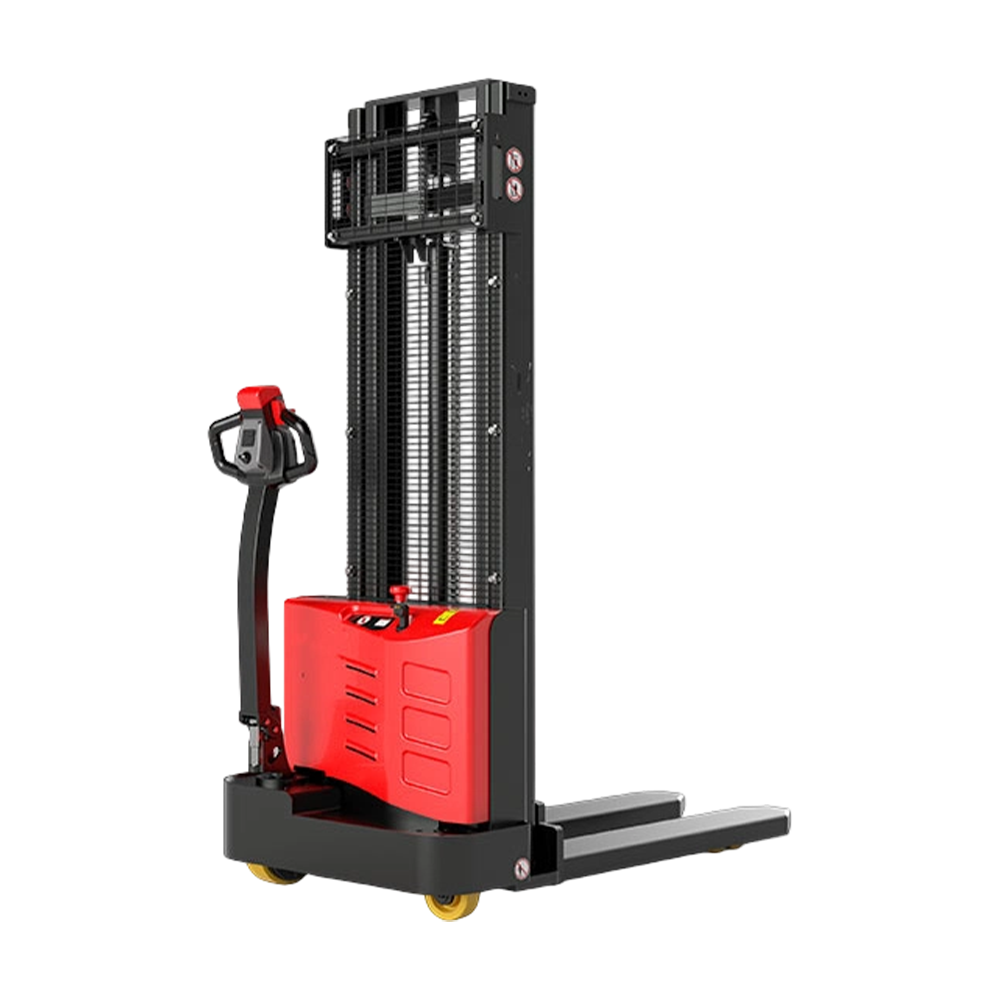
In the fast-evolving landscape of modern logistics and manufacturing, the cost of warehousing space is climbing at an alarming rate. To accommodate massive volumes of goods within limited floor space, warehouses are building higher racks and narrowing aisles. In such high-density storage environments, traditional handling methods and bulky heavy-duty fuel-powered equipment fall short. At this juncture, the Electric Stacker has rapidly emerged as an indispensable core material handling equipment for modern warehouses and intelligent logistics centers, driven by its compact body structure and robust vertical lifting capabilities.
The core positioning of the Electric Stacker is not merely that of a simple "goods transporter," but rather as a "vertical hub" bridging high-level multi-tier storage racks and floor-level material flow. It not only takes over the entire process from unloading platforms to stock placement but also demonstrates exceptional maneuverability within extremely tight turning radiuses. For enterprises facing soaring labor costs and spatial bottlenecks, introducing this high-efficiency handling equipment on a large scale is a crucial step toward breaking through operational ceilings.
To intuitively showcase the spatial and efficiency dividends brought by equipment upgrades, we can examine the performance differences between the Electric Stacker and traditional counterbalanced equipment under actual operating conditions through a set of typical warehousing metrics:
| Core Warehousing Metrics | Traditional Counterbalanced Equipment | Modern Electric Stacker | Data Improvement and Operational Value |
|---|---|---|---|
| Aisle Width Required (AST) | Usually requires 3.5 meters to 4.0 meters | Requires only about 2.0 meters to 2.5 meters | Racks spacing is greatly reduced, increasing total warehouse storage capacity by 30% to 40% |
| Dead Weight and Floor Loading | Extremely heavy body, placing high stress on floor weight limits | Modular lightweight design, relatively low overall dead weight | Perfectly suited for multi-story warehouses on the second floor and above or older facilities with weight limits |
| Energy Conversion and Emissions | High fuel consumption with exhaust emission issues | Full electric drive, zero emissions and low noise | Meets strict environmental requirements for indoor enclosed warehousing, significantly reducing energy and ventilation costs |
| Operation Accuracy and Fatigue | Relies on mechanical hydraulics; prolonged operation causes fatigue | Electronic power steering and fingertip micro-motion control | Effectively reduces operational fatigue and increases overall cargo turnover per worker per shift |
Through the comparison above, it is evident that the Electric Stacker holds an overwhelming advantage in space optimization, cost control, and operational precision. However, allowing these hardware advantages to land smoothly in actual large-scale warehousing or newly established logistics base projects requires more than just equipment parameter sheets. Enterprise clients undertaking bulk equipment renewals truly need a reliable partner with a stable supply chain, rich industry experience, and full-lifecycle services.
This precisely highlights the value accumulated by Shanghai HanDavos International Trading Co., Ltd. over more than 20 years in the material handling equipment industry. As a core branch of Kunshan Hanzhi, we have grown into a powerful integrated enterprise group. When enterprises decide to fully equip their logistics centers with the Electric Stacker, delivery schedules, quality, and after-sales support become the three core pillars of project implementation. Backed by our strategic headquarters located in the transportation hub of Kunshan City, we own over 20,000 square meters of modern standardized warehouses. Within this massive logistics and reserve base, we stock a massive inventory of brand-new handling equipment, premium used equipment, and a complete range of spare parts and attachments.
Sufficient and diversified inventory strength means that whether an enterprise project requires standard Electric Stacker arrays or customized equipment tailored to unique warehousing environments, we can support one-stop centralized allocation and rapid order fulfillment, minimizing the waiting period for project launch. Furthermore, the sustained and efficient operation of equipment relies on strong technical support behind the scenes. Shanghai HanDavos International Trading Co., Ltd. has established a professional full-service team covering technology, marketing, and after-sales maintenance. From preliminary site surveys and equipment selection guidance to subsequent technical training and maintenance planning, our experienced engineers provide end-to-end guidance, completely resolving worries for enterprises when introducing high-frequency operating equipment.
Choosing a high-performing Electric Stacker and deeply cooperating with a comprehensive enterprise group possessing a global service vision is not merely a simple equipment procurement choice. Rather, it is a strategic decision for enterprises to optimize their warehousing and logistics chains, reduce comprehensive operating costs, and maximize long-term economic value.
In-Depth Analysis of Core Parameters and Superior Performance of the Electric Stacker
Perfect Matching of Load Capacity and Lifting Height
When evaluating and introducing the Electric Stacker, the most fundamental and critical physical indicators are the combination of load tonnage and mast lifting height. Unlike the planar horizontal movement of ordinary pallet trucks, full electric stackers need to vertically lift tons of goods to high altitudes of several meters, placing extremely high demands on mechanical structural stability and hydraulic control precision.
Currently, mainstream Electric Stacker load capacities on the market typically cover 1 ton to 2.5 tons. To help enterprise clients make the most precise equipment selections during project planning, we can horizontally compare the core parameters and applicable working conditions of different tonnage levels:
| Core Tonnage Level | Standard Lifting Height Range | Allowable Load Center Distance at Full Load | Most Suitable Industrial Application Scenarios |
|---|---|---|---|
| 1.0 Ton Lightweight Series | 1.6 meters - 3.0 meters | 600 mm | Standard ceiling height warehouses, light industry parts storage, small commercial distribution centers |
| 1.5 Ton to 2.0 Ton Standard Series | 3.0 meters - 4.5 meters | 600 mm | Standard high-level beam racking, third-party logistics (3PL) transit warehouses, standard pallet stacking |
| 2.5 Ton Heavy-Duty High-Lift Series | 4.5 meters - 5.5 meters (higher options customizable) | 600 mm | Heavy manufacturing finished goods warehouses, high-density multi-tier vertical racking, bulk goods loading and unloading |
It is worth noting that as the lifting height increases, the Electric Stacker faces a certain physical characteristic known as "load capacity reduction"—meaning that when the mast is raised to its highest point, the actual allowable weight it can carry is lower than the rated load. Therefore, during the equipment selection phase prior to project implementation, the maximum rack height of the warehouse must be accurately measured.
It is precisely in such steps of deep customization and precise selection that an experienced service team proves invaluable. As an established enterprise in the industry, Shanghai HanDavos International Trading Co., Ltd. relies on over 20 years of profound expertise in the material handling field. It not only possesses over 20,000 square meters of modern standard warehouses and sufficient spot inventory but also gathers a team of experienced technical engineers. Whether matching standard-size equipment or recommending devices for non-standard rack locations and special load requirements, technical experts can provide full-process technical guidance from parameter verification to solution implementation based on actual enterprise warehouse blueprints, ensuring every specification of the Electric Stacker perfectly matches on-site operating conditions.
Drive System and Core Powertrain
If the mast and forks determine the working height and boundaries of the Electric Stacker, then the drive system and hydraulic pump station inside its chassis serve as the "heart and muscles" of the entire machine.
In modern high-intensity and high-turnover warehousing operations, the technological iteration of drive motors directly determines equipment uptime and routine maintenance costs. Compared to traditional direct current (DC) motors, premium Electric Stackers comprehensively adopt advanced alternating current (AC) drive motor systems. Because AC motors eliminate consumable carbon brushes, they fundamentally achieve true maintenance-free operation while displaying strong torque output and smoothness during low-speed climbing and high-speed full-load acceleration.
To better understand the core performance differences of powertrains, we can analyze the technical performance of AC drive systems versus traditional systems through the following table:
| Power and Control Core | Traditional Direct Current (DC) System | Modern Alternating Current (AC) Drive System | Actual Impact on Daily Operations |
|---|---|---|---|
| Motor Maintenance Frequency | Requires regular inspection and carbon brush replacement; high maintenance costs | Completely eliminates carbon brushes, achieving structural maintenance-free status | Significantly reduces workshop downtime and cuts down comprehensive maintenance labor costs |
| Energy Recovery Efficiency | Braking energy is directly wasted and converted into heat | Equipped with regenerative braking functionality | Automatically recovers part of electrical energy during deceleration or downhill movement, extending single-charge endurance |
| Speed Control and Micro-motion | Occasional stuttering during startup and steering; moderate fine-tuning precision | Frequency conversion stepless speed regulation, precisely controlling every millimeter-level displacement | Ensures smoother and safer movement and alignment in narrow rack spaces, avoiding cargo collisions |
| Hydraulic Pump Integration | Traditional gear pumps generate high noise and rapid temperature rise | Precision low-noise hydraulic pump station with pressure compensation design | Ensures absolute safety and a low-noise working environment during heavy-duty lifting and smooth descent |
In complex industrial logistics settings, any minor power stutter can lead to high-altitude cargo tilting or damage. Leveraging its strong strength in long-term global supply chain integration, Shanghai HanDavos International Trading Co., Ltd. offers a product portfolio covering powertrain configurations of all major manufacturing processes and technical standards. Not only can it directly provide original factory complete machines from major well-known brands, but it also wholesals and exports full series of forklift spare parts and various high-quality attachments year-round. When enterprises require routine maintenance, component replacement, or system upgrades for their powertrains during subsequent use, they can obtain sufficient original spare part support and rapid logistics responses, thoroughly relieving them of operational concerns.
Battery Technology Revolution: Endurance and Energy Management of the Electric Stacker
In today's warehousing and logistics landscape moving toward 24/7, high-intensity operations, the endurance capacity of equipment is directly related to the operational efficiency of the entire logistics system. As the energy source of the Electric Stacker, every innovation in battery technology is quietly changing warehouse operating models. The "power anxiety" of multi-shift operations that once plagued enterprises is becoming history with the popularization of new energy management solutions.
Currently, when enterprises introduce the Electric Stacker, they primarily face choices between two mainstream battery technology routes. To help enterprises make optimal decisions based on their work shift systems and cost budgets, we can horizontally compare the core metrics of these two solutions:
| Battery Technology Metrics | Traditional Lead-Acid Battery | Modern Lithium-ion Battery | Actual Value for Daily Operations |
|---|---|---|---|
| Single-Charge Endurance | Moderate; power drops slightly as charge level decreases | Excellent, maintaining consistently strong power output throughout | Supports longer continuous heavy-load operations under a full charge |
| Charging Time and Method | Takes longer (typically 8-10 hours), requiring dedicated charging rooms | Extremely fast charging (supports 1-2 hour quick full charge), supporting opportunity charging anytime | Enables fragmented "opportunity charging," perfectly adapting to 24-hour multi-shift operations |
| Maintenance and Watering Requirements | Requires regular manual addition of distilled water and acid corrosion cleaning | Zero maintenance, no daily watering needed, zero hazardous gas emissions | Significantly saves time and safety protection costs associated with dedicated maintenance personnel |
| Cyclic Service Life | Approximately 1000 - 1500 cycles | Approximately 3000+ cycles, lasting through the machine's entire lifecycle | Reduces battery replacement frequency across the full lifecycle, significantly cutting long-term comprehensive expenditures |
For many enterprises needing to cope with multi-shift high-intensity turnover, selecting high-capacity lithium battery versions of the Electric Stacker allows equipment to undergo "opportunity charging" during employee shift changes (such as lunch breaks or brief changeover intervals), completely eliminating the tedious pain point of spare battery swaps.
However, superior endurance relies not only on the chemical properties of the battery itself but also on intelligent management systems. Modern high-quality Electric Stackers are universally equipped with advanced Battery Management Systems (BMS), capable of real-time monitoring of the temperature, voltage, and charge-discharge status of every individual cell, preventing overcharging and over-discharging to maximize the overall lifespan of the battery pack from the underlying logic.
When implementing these advanced energy solutions into specific warehousing upgrade projects, finding partners with strong supply chain integration capabilities is crucial. As an experienced enterprise in the material handling equipment industry, Shanghai HanDavos International Trading Co., Ltd. relies on over 20 years of industry cultivation, boasting over 20,000 square meters of modern standard warehouses at its Kunshan headquarters, stocking massive inventories of brand-new and premium used handling equipment year-round, while establishing one-stop supporting advantages in core component supply chains such as batteries, motors, and electronic controls. When enterprise clients need to configure specific specifications or energy management systems tailored to specific operating intensities, the robust spot inventory and diversified product matrix of Shanghai HanDavos International Trading Co., Ltd. can provide perfect customized support. Meanwhile, its professional technical engineering team is always ready to provide comprehensive solutions ranging from energy selection validation to subsequent battery maintenance, ensuring every Electric Stacker put into operation releases long-lasting and efficient power.
Source Factory Strength: Ensuring Quality and Depth of OEM/ODM Customization for the Electric Stacker
In modern warehousing and logistics systems, the stable operation of equipment is directly linked to an enterprise's core operational efficiency. For large-scale warehousing projects, whether the batch-imported Electric Stacker features solid manufacturing craftsmanship, rigorous quality inspection standards, and flexible customization capabilities is the key to determining whether a project can land successfully. Many enterprises often find in actual operations that standardized market-available equipment is frequently difficult to fully fit complex factory structures or special cargo dimensions, placing extremely high demands on the comprehensive capabilities of the source manufacturing factory.
To give enterprises a reliable basis when evaluating the manufacturing end, we can directly compare core metrics and capabilities between standard industrial manufacturing processes and general assembly OEM models:
| Manufacturing and QC Core Steps | General Assembly or OEM Mode | Strong Source Factory Manufacturing System | Actual Protection for Project Implementation |
|---|---|---|---|
| Raw Material Selection and Steel Standards | Uses ordinary low-grade steel; prone to slight mast deformation under long-term full load | Selects high-strength manganese steel profiles with extremely high structural rigidity and bending resistance | Ensures the Electric Stacker maintains absolute stability when operating at maximum lifting height under full load |
| Welding Craftsmanship and Frame Structure | Primarily manual welding; weld uniformity fluctuates based on personal skill | Robot precision automated welding, zero defects and bubble-free welds | Greatly enhances overall structural fatigue resistance, extending equipment service life in harsh operating conditions |
| Pre-Factory Testing Standards | Performs only simple no-load power testing and visual appearance checks | Undergoes full-load limit lifting tests, ramp anti-slip braking tests, and continuous fatigue tests | Ensures equipment is ready for immediate use upon site arrival, significantly lowering initial failure rates and repair risks |
| Customization Response Speed | Lacks independent R&D capability; struggles to execute non-standard modifications based on blueprints | Possesses strong OEM/ODM R&D and rapid-change production capabilities | Perfectly adapts to special fork sizes, lifting heights, and special body protection requirements across different industries |
Beyond rigorous manufacturing processes, the smooth progression of projects also depends heavily on robust supply chain spot support and logistics fulfillment capabilities. As a comprehensive and powerful enterprise deeply rooted in the material handling equipment industry for over 20 years, Shanghai HanDavos International Trading Co., Ltd. owns over 20,000 square meters of modern standardized warehouses at its Kunshan headquarters. Within this massive warehousing and logistics hub, massive inventories of brand-new and high-quality Electric Stacker complete machines, full series of spare parts, and various dedicated attachments are stocked year-round.
This deep spot inventory and scaled manufacturing background enable Shanghai HanDavos International Trading Co., Ltd. to easily support one-stop bulk equipment procurement and rapid order fulfillment. Whether dealing with routine standard batch orders or OEM/ODM solutions requiring deep customization of fork spacing, special lifting heights, and exclusive corporate visual identities, its experienced engineering technology and marketing service teams can provide comprehensive technical validation and fulfillment guarantees, ensuring every batch of equipment is delivered on time and in perfect condition to each enterprise warehousing project site.
Return on Investment (ROI): How the Electric Stacker Significantly Reduces Comprehensive Operating Costs
When evaluating technological upgrades for warehousing and logistics equipment, the core metrics most cared about by financial departments and project management teams are always the Return on Investment (ROI) and Total Cost of Ownership (TCO). In initial planning stages, many enterprises often fixate solely on initial equipment acquisition costs while ignoring the massive proportions that daily energy consumption, labor efficiency, and maintenance expenses account for in long-term operations. Comprehensively introducing high-performance Electric Stackers represents a critical breakthrough for enterprises seeking to reduce costs, increase efficiency, and optimize asset structures.
To intuitively demonstrate the remarkable operational economic advantages of the full electric stacker, we can systematically compare the performance of traditional handling equipment versus modern Electric Stackers across core cost dimensions:
| Core Operating Cost Dimensions | Traditional Handling/Fuel Equipment Mode | Modern Electric Stacker Mode | Actual Impact on Enterprise Finance and ROI |
|---|---|---|---|
| Daily Power/Energy Consumption | High fuel costs, or outdated electronic controls leading to high power losses | AC drive paired with high-efficiency lithium batteries; unit operating power consumption is extremely low | Compared to internal combustion equipment, energy expenditures can be cut by 70% to 80% or more |
| Labor Efficiency and Output | Purely manual or semi-electric; high labor intensity, low cargo transfer volume per worker | Full electric assistance with fingertip precise micro-motion control, greatly accelerating handling pace | Significantly increases overall cargo turnover per worker per shift, indirectly saving labor allocation costs |
| Routine Maintenance and Consumables | Complex mechanical structures; engines and traditional carbon brush motors require frequent overhauls | Modular maintenance-free design; virtually no complex fluid or consumable replacements needed | Reduces annual equipment repair hours and spare parts replacement expenses, with equipment uptime approaching 100% |
| Equipment Trouble-Free Operating Cycle | Numerous vulnerable parts; failure rates and downtime losses increase with age | Sturdy and durable structure; long service life for core electronic controls and hydraulic systems | Greatly minimizes production line stagnation and hidden financial losses caused by sudden equipment failures |
As seen from the cost matrix above, although high-quality Electric Stackers place greater emphasis on quality in their initial investment, their extremely low energy consumption, near-zero routine maintenance costs, and exponentially increased per-worker operational efficiency typically allow them to recover price differences through saved expenditures within just over a dozen months of operation, releasing substantial net profit space for enterprises over the equipment lifecycle.
However, turning paper ROI into tangible financial gains requires not only superior equipment quality but also stable and reliable logistics supply chains and full-lifecycle technical support. Shanghai HanDavos International Trading Co., Ltd., deeply rooted in the material handling equipment industry for over 20 years, fully understands the core pain points enterprises face when calculating total investment costs. Backed by its strategic headquarters located at the transportation hub of Kunshan City, the company owns over 20,000 square meters of modern standard warehouses, stocking massive inventories of new equipment complete machines, premium used equipment, and a comprehensive assortment of parts and attachments year-round.
When enterprises need to comprehensively upgrade existing warehousing logistics chains or introduce bulk Electric Stackers, Shanghai HanDavos International Trading Co., Ltd. leverages its one-stop comprehensive procurement strength to help enterprises minimize supply chain intermediate links and lower initial fixed asset investment costs. Meanwhile, the professional technical and after-sales service teams established by the company can provide enterprises with long-term operational consulting, preventive maintenance guidance, and rapid spare part supply, ensuring every piece of equipment put into production runs at peak condition, building a low-cost, high-return efficient logistics channel for enterprises.
Safety First: Multiple Protection Designs and International Compliance Certifications of the Electric Stacker
In modern, high-turnover warehouse environments, high-altitude operational safety remains a permanent red line for corporate management. When tons of goods are lifted to heights of several meters by an Electric Stacker, any minor mechanical loss of control or operational error can bring incalculable safety hazards. Therefore, international industrial vehicle standards impose extremely strict regulations on the safety protection systems of full electric stackers, making them core hard metrics that enterprises must heavily scrutinize during project introduction and equipment evaluation.
To provide project leads and safety managers with a clear understanding of the technical evolution of modern industrial-grade stackers in safety protection, we can directly compare the safety configurations of traditional basic handling equipment versus modern standard Electric Stackers:
| Safety Protection Dimensions | Traditional Basic/Low-Config Handling Equipment | Modern Standard Electric Stacker | Actual Protection for On-Site Operations and Compliance |
|---|---|---|---|
| Emergency Evasion and Anti-Collision Mechanism | Lacks active anti-collision protection; relies entirely on operator reaction in emergencies | Equipped with a large area "belly switch" (emergency reverse driving button) on the body head | When operators are blocked reversing in narrow aisles, body contact instantly triggers forward movement, preventing personnel crushing |
| Ramp Anti-Slip and Parking Brake | Relies on simple mechanical brakes; prone to rolling on slopes or during parking | Electromagnetic automatic braking system integrated with anti-rollback protection | Even under full load parked on inclines or loading tailboards, wheels are securely locked preventing rolling |
| High-Altitude Load Limiting and Anti-Crush Structure | No automatic speed restriction or overload protection during ascent; highly prone to tipping | Built-in overload overflow valves and mast lifting limit switches with automatic turning deceleration | When rated load is exceeded or the mast reaches maximum height, the system forcibly restricts over-limit actions and automatically reduces driving speed based on steering angles |
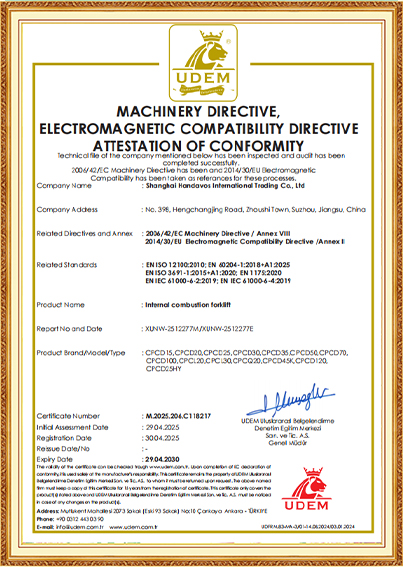
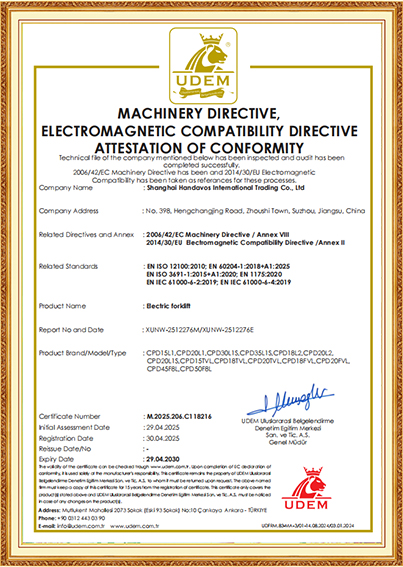
| International Authoritative Safety Certifications | Lacks qualifications or passes only single local testing | Strictly passes international authoritative quality and safety compliance certifications like CE and ISO | Perfectly matches EHS (Environment, Health, and Safety) entry standards of major multinational enterprises and strict factories globally |
Under the reinforcement of multiple active and passive protection mechanisms, modern Electric Stackers minimize human operational risks and cargo drop probabilities on warehousing sites. However, equipment safety design is only the first step; ensuring the compliance, safety, and long-term stability of the entire warehousing and logistics project requires high-quality compliant supply chain backing.
Shanghai HanDavos International Trading Co., Ltd., having cultivated the material handling equipment industry for over 20 years, consistently places equipment safety compliance and quality as its top priority. As a core branch of Kunshan Hanzhi, its headquarters situated in accessible Kunshan features over 20,000 square meters of modern standardized warehouses, constantly stocking brand-new handling equipment, high-quality used equipment, and full series of compliant replacement parts that strictly pass international safety standards.
When enterprises need to introduce large quantities of Electric Stackers meeting international safety standards for key logistics projects, Shanghai HanDavos International Trading Co., Ltd. relies on its strong spot integration capabilities and professional technical teams to provide enterprises with one-stop support ranging from compliance qualification inspections and on-site safety validation to complete preventive maintenance solutions. Through rigorous equipment quality control and professional technical escort, every warehousing link is ensured to operate smoothly on an absolutely safe, compliant, and efficient track.
Core FAQ and Selection Guide for the Electric Stacker
Q1: What is the factory's standard delivery lead time when placing bulk orders for the Electric Stacker?
For project upgrades of large-scale warehouses or logistics centers, timely equipment delivery directly correlates with the commissioning progress of the overall engineering project. Under normal circumstances, standard equipment models feature mature production processes and stable supply chains, resulting in shorter routine spot allocation and pre-factory safety quality inspection cycles. For projects with special customization requirements—such as non-standard modifications requiring heightened masts, adjusted fork dimensions, or specific corporate identity color painting—additional technical blueprint confirmations and flexible production line scheduling are required.
At this point, strong supply chains and warehousing integration capabilities become critically essential. Shanghai HanDavos International Trading Co., Ltd., possessing profound industry accumulation, relies on its strategic headquarters at the transportation hub of Kunshan City to build over 20,000 square meters of modern standard warehouses. Within this massive spot reserve base, massive quantities of brand-new and high-quality used handling equipment, full series of spare parts, and dedicated attachments are stocked year-round. This sufficient and diversified spot inventory support maximizes the compression of intermediate supply chain links, providing rapid one-stop order fulfillment and flexible logistics container loading and delivery support for major projects, ensuring project timelines land on schedule.
Q2: Is the Electric Stacker suitable if warehouse floors are uneven or feature minor inclines?
The flatness and friction coefficient of warehouse floors directly impact the daily driving stability of electric stackers and the wear rate of drive wheels. If floors feature minor unevenness, expansion joints, or slight inclines at loading dock junctions, ordinary hard plastic wheels easily generate severe jolting or even cause goods to sway at high elevations.
Targeting such operating conditions, modern high-quality Electric Stackers typically come standard or optional with high-elasticity wear-resistant polyurethane (PU) drive wheels and load wheels, paired with scientific balancing support systems. Polyurethane material not only delivers exceptional shock absorption and cushioning performance but also maximizes tire lifespan while ensuring grip. Prior to equipment selection, the experienced technical engineering team of Shanghai HanDavos International Trading Co., Ltd. can assist with targeted wheel material and shock absorption system validations based on actual floor condition data and site blueprints provided by enterprises, ensuring equipment operates smoothly and efficiently on specific workshop floors.
Q3: What warranty policies and global after-sales spare parts support does the factory provide for the Electric Stacker?
The long-term stable operation of equipment relies on a sound after-sales warranty system and timely replenishment of consumable parts. When enterprises introduce heavy-duty, high-frequency operating equipment, their primary concern is the lack of original factory technical support when core components (such as drive motors, electronic control systems, hydraulic pump stations, and battery packs) experience failures.
To thoroughly relieve enterprises of future worries, Shanghai HanDavos International Trading Co., Ltd. not only provides strictly inspected high-quality complete machines but also relies on its strong spare parts wholesale and export advantages to stock full series of forklift spare parts and attachments year-round. The professional technical support and after-sales maintenance teams established by the company provide timely remote technical guidance and comprehensive maintenance planning. When equipment requires routine maintenance or consumable part replacements during operation, original spare part support is delivered with extremely fast response speeds, keeping equipment uptime at optimal states.
Q4: How to calculate and precisely match the appropriate size of the Electric Stacker based on warehouse aisle width (AST)?
In the design of high-density vertical warehouses, rack aisle width (AST) directly determines the overall storage capacity of the warehouse. If the turning radius of the stacker is too large, it forces aisles to widen, thereby wasting precious warehousing space.
To help enterprises make the most scientific and spatially economical selection decisions, we can use industry-standard right-angle stacking aisle width calculation logic for parameter comparisons:
| Selection Calculation Core Parameters | Traditional Counterbalanced Forklift Aisle Requirements | Modern Electric Stacker Aisle Requirements | Actual Benefit to Warehouse Space Planning |
|---|---|---|---|
| Minimum Right-Angle Stacking Aisle Width (AST) | Usually requires about 3.5 meters to 4.0 meters | Requires only about 2.1 meters to 2.6 meters | Greatly compresses rack spacing, increasing overall warehouse storage density by over 30% |
| Vehicle Turning Radius (Ra) | Larger, heavily constrained by body length/width and rear counterweights | Compact body design paired with electronic steering, minimal turning radius | Perfectly adapts to efficient rotation and precise alignment stacking inside narrow aisles |
In actual operations, calculation formulas typically need to comprehensively consider pallet sizes (such as standard 1200mm × 1000mm), longitudinal cargo lengths, distances from front/rear wheels to the fork roots (designated as dimension x), and safe operating clearance margins (typically reserving a 200mm buffer). If you need professional advice regarding specific aisle planning and equipment parameter matching, you are welcome to contact the senior technical expert team of Shanghai HanDavos International Trading Co., Ltd. at any time. Drawing upon over twenty years of accumulated industry experience, we will tailor material handling and equipment selection solutions best matching your site conditions, helping enterprises achieve a massive leap in warehousing and logistics efficiency.
